
In-Network With Most Commercial Insurers










*Please note that at this time, we are not in network with Medicaid/Medi-Cal
A Comprehensive, Evidence-Based Approach to Teen Treatment

Adolescence is a period of rapid developmental change, and the mental health and substance use challenges teens face are rarely simple. Anxiety and depression often travel together. Trauma shapes how teens respond to stress. Substance use frequently emerges as an attempt to self-regulate. School difficulties, family conflict, and peer dynamics weave through the clinical picture. A treatment approach that addresses only one part of this picture leaves too much in place.
At Muir Wood, our therapies are selected and integrated to address the full clinical picture for each teen. We draw from the evidence-based modalities established as effective for adolescent mental health and substance use — Cognitive Behavioral Therapy, Dialectical Behavior Therapy, Acceptance and Commitment Therapy, trauma-informed care modalities such as Internal Family Systems and nervous system regulation, experiential exercises, family systems work, and psychiatric care when indicated — and we deliver them through an integrated, multidisciplinary team that knows each teen individually. The therapies matter. The team delivering them matters more.
The most important element of a positive impact on care is the relationship that we develop with the clients. Research backs that up. Every single person on the team is a contributor to treatment.
— Dr. Ian Wolds, PsyD, Chief Clinical Officer
Every teen who comes to Muir Wood receives an individualized treatment plan built from a thorough initial assessment. From the first days of care, our team works to understand the full scope of what your teen and family are experiencing — so that the treatment plan is specific, purposeful, and grounded in clinical reality. Adolescents change as they heal, and our clinical understanding deepens over time. Our team reassesses regularly and builds on what we’ve learned — not because the plan has failed, but because our picture of your teen grows clearer and richer as treatment progresses.
Multidisciplinary Clinical Assessment
Effective treatment begins with a thorough, multidisciplinary clinical assessment. From the first days of care, our team works from every angle — mental health symptoms, trauma history, family dynamics, social functioning, self-identity, developmental stage, and conditions such as ADHD when clinically relevant. When substance use is present, we assess the patterns and the role it may be playing as a coping mechanism. Our assessment process includes:
- Nursing assessment conducted by an LVN or RN
- Initial psychiatric evaluation with an MD or psychiatric mental health nurse practitioner
- Biopsychosocial assessment by the teen’s assigned therapist
- Supplementary assessments when clinically indicated — history and physical exam, nutritional assessment, psychological or neuropsychological assessment through trusted third-party providers
This comprehensive picture enables us to develop a treatment plan that addresses immediate needs while working toward longer-term stability. Because adolescents are constantly growing and changing, treatment plans evolve too — our clinical team reassesses weekly in team review and adjusts the plan as your teen progresses.
Individualized Clinical Therapies
The core of Muir Wood’s clinical work happens through three interlocking therapeutic relationships — individual, family, and group. Each does something the others cannot, and together they form the therapeutic backbone of treatment.
Individual Therapy
Every teen in our program works with a primary therapist — the clinician who holds the overall picture of the teen’s treatment, coordinates with the broader clinical team, and guides the teen’s individual therapeutic work. Teens in residential treatment receive at least two individual sessions per week, led by our team of therapists and recovery counselors, and paced to each teen’s clinical needs. In these sessions, teens explore the experiences, thoughts, and patterns that have brought them to treatment — and build the insight and skills that will allow them to respond differently going forward.

The therapeutic relationship itself is a significant source of change. Adolescents who feel genuinely seen, respected, and understood by their clinician engage more deeply with treatment, take more clinical risks, and sustain more progress after discharge. Our primary therapists are trained not just in clinical modalities but in the relational skills that adolescent treatment demands.
Family Therapy
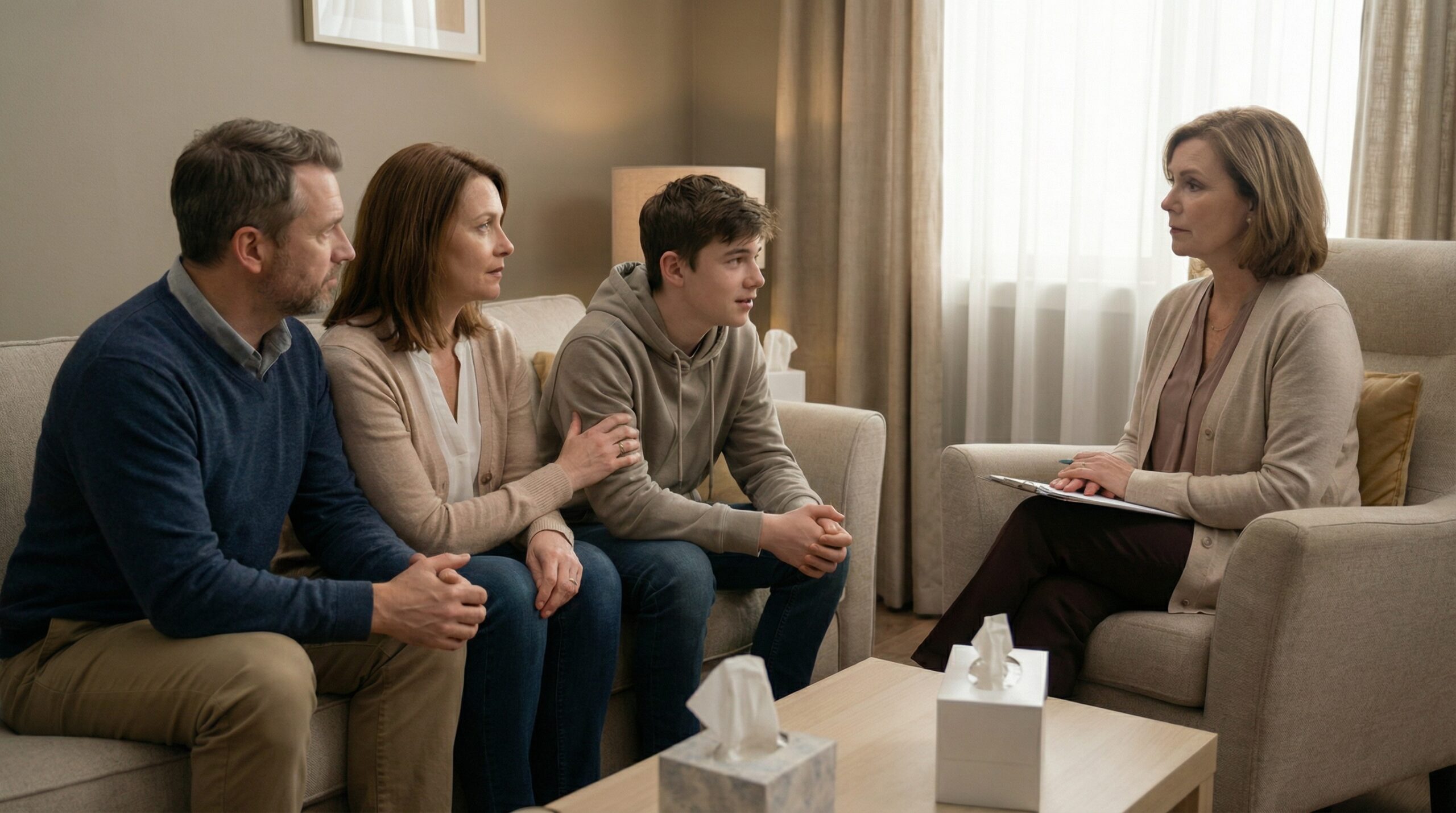
Family therapy at Muir Wood is conducted by your teen’s primary therapist — the same clinician your teen sees in individual sessions — so the clinical picture stays unified across both relationships. Weekly family therapy sessions explore the specific dynamics at play in your family and help parents, teens, and siblings build new patterns of communication, accountability, and repair.
Family involvement at Muir Wood is not an add-on. It is central to how we work, because adolescent treatment rarely produces lasting change when the family system doesn’t change alongside the teen. Our full family programming — family therapy, twice-weekly parent education classes, a weekly parent support group, regular treatment team huddle calls, and our 16-week aftercare coaching program — is designed to give families parallel tracks of growth during your teen’s time in treatment.
Group Therapy
Group therapy offers something individual sessions cannot: the experience of being among peers who are navigating similar challenges. For adolescents in particular, the shared space of group therapy reduces shame, builds connection, and allows teens to see themselves reflected in each other’s stories. Hearing another teen describe an experience you thought was yours alone is a uniquely powerful therapeutic moment.

Muir Wood’s groups are led by experienced adolescent clinicians and intentionally sized to be supportive rather than overwhelming. Group topics span skill-building (emotion regulation, communication, distress tolerance), psychoeducation (understanding substance use, understanding trauma, understanding anxiety and depression), and process-oriented work where teens share and respond to each other’s experiences. Gender-separate residential campuses allow groups to focus on the specific developmental dynamics of adolescent boys and girls without the cross-currents of coed social dynamics.
Evidence-Based Modalities We Use
Within the individual, family, and group therapy structure above, Muir Wood’s clinicians draw on specific evidence-based therapeutic modalities proven effective for adolescent mental health and substance use treatment. Which modalities are used for any given teen depends on the clinical picture, the presenting concerns, and what the teen’s primary therapist judges most appropriate. Our team is trained in multiple approaches so the treatment can meet the teen, not the other way around.
Cognitive Behavioral Therapy (CBT)
Cognitive Behavioral Therapy is the foundational evidence-based approach for most adolescent mental health conditions, including depression, anxiety, OCD, and trauma responses. CBT helps teens understand the relationships among thoughts, feelings, and behaviors — and equips them with practical skills for recognizing unhelpful thought patterns, interrupting them, and responding differently. In adolescent CBT, we emphasize accessible language, real-life examples, and skill-building the teen can actually use between sessions.
CBT techniques appear across Muir Wood’s individual therapy, group programming, and family work. Teens learn to identify the cognitive distortions that fuel anxiety and depression, develop behavioral activation strategies when depression has reduced their engagement with life, and practice exposure-based techniques for anxiety when appropriate. For teens with OCD, CBT is often combined with Exposure and Response Prevention (ERP) strategies, which are used as part of an individualized treatment plan when clinically indicated.
Dialectical Behavior Therapy (DBT-Informed Skills)
Dialectical Behavior Therapy was originally developed for adults with significant emotional dysregulation, and its skills framework has become one of the most valuable additions to adolescent treatment. DBT teaches concrete skills in four domains: mindfulness, distress tolerance, emotion regulation, and interpersonal effectiveness. For adolescents, these skills address some of the most common challenges of the teen years — emotional intensity, impulsivity, conflict with parents and peers, and the urge to act on painful emotions in ways that cause harm.
At Muir Wood, DBT-informed skills are integrated into both group programming and individual therapy as part of the standard residential experience. DBT skills help teens recognize internal signs of activation in the moment, pause before reacting, and employ effective strategies to cope — practical tools they can carry into daily life during and after treatment.
Trauma-Informed Care
Most teens who come to Muir Wood have experienced some form of adversity that shapes how they see themselves, relate to others, and respond to stress. What sometimes gets labeled as defiance, withdrawal, or acting out is often a protective response rooted in past pain. Our clinical philosophy is to ask “what happened to you?” or “what is this behavior communicating?” before “what’s wrong with you?”
In practice, trauma-informed care at Muir Wood means understanding that every issue or problematic behavior present in a teen’s life comes from some underlying cause in their personal history. Past traumas and adverse experiences affect how people think, feel, act, and react today. They shape the way teens experience themselves, other people, and the situations they encounter in daily life — including their perceptions, emotional reactions, memories, impulses, and sense of safety. Trauma-informed care means we aim to create emotional safety for our clients through predictable routines, clear expectations, consistent relationships, and compassion throughout all of our work. It means that every member of our team, not just the therapists, understands how a teen’s past experiences shape the way they present in our care, and how to respond in ways that support self-regulation and healing rather than deepening distress.
Psychiatric Evaluation and Medication Management
Some teens benefit from psychiatric medication as part of their treatment plan — particularly when anxiety, depression, mood dysregulation, or OCD symptoms are significant enough that therapy alone isn’t producing sufficient relief. At Muir Wood, our psychiatric team follows a non-ideological, least-necessary approach. Medication is used only when clinically indicated, always in combination with evidence-based therapy, and always in close collaboration with families.
A comprehensive psychiatric evaluation is included in each teen’s initial assessment. When medication is appropriate, our adolescent psychiatrists and psychiatric nurse practitioners (PMHNPs) consider the teen’s full clinical picture — current symptoms, co-occurring conditions, medication history, family history, and the teen’s own response to past treatments — before making recommendations. Parents are full partners in medication decisions. Our psychiatric team explains the reasoning, the options, and the tradeoffs in language families can actually use. When medication is not indicated, we say so.
Experiential and Holistic Therapies
Traditional talk therapy does much of the work of treatment, but it doesn’t do all of it. For adolescents especially, healing happens through the body, through creativity, through movement, and through connection with the natural world — not only through conversation. Experiential and holistic therapies are part of every teen’s daily life at Muir Wood, not as add-ons but as core elements of how we help teens regulate emotions, build skills, and reconnect with themselves.
Mindfulness and Emotional Regulation Practices
Mindfulness practice gives teens a practical tool for managing the intense emotional states that drive so much adolescent struggle. Learning to notice thoughts without being overwhelmed by them, to feel emotions without acting on them impulsively, and to return attention to the present moment when it’s drifted into rumination or worry — these are foundational skills we build throughout treatment. Mindfulness appears in individual therapy, group programming, and daily practices integrated into the campus rhythm.
Art and Music Therapy
Art and music offer teens ways to process and express experiences that are difficult to put into words. For adolescents working through trauma, grief, identity questions, or emotional overwhelm, creative expression can open therapeutic doors that conversation alone cannot. Experiential groups incorporate visual art, music, and creative practice as part of our regular programming, led by clinicians and experienced facilitators.
Outdoor and Nature-Based Activities
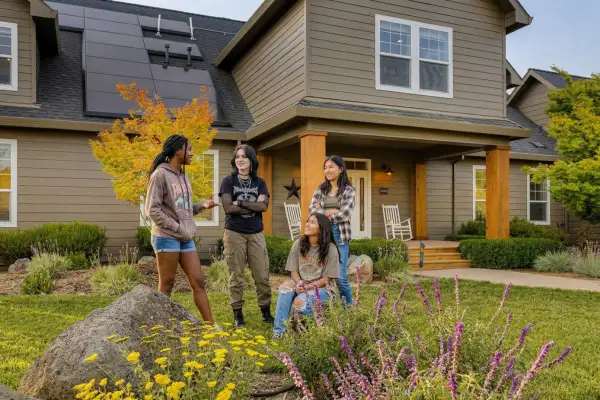
Our California campuses are set in serene, nature-rich environments — in Sonoma County, the Central Valley near Clovis, and Southern California’s Riverside area. Time outdoors is part of daily life, not an occasional field trip. Research consistently demonstrates that time in nature supports emotional regulation, reduces stress, and deepens the therapeutic work. Teens hike, spend time in campus gardens, engage in outdoor experiential groups, and benefit from a treatment environment that doesn’t look or feel like a clinical institution.
Movement and Wellness Activities
Physical movement, balanced nutrition, sleep routines, and basic wellness practices are integrated into the daily schedule at Muir Wood. These aren’t extras. They are foundational to adolescent mental health — a teen whose sleep is wrecked, whose nutrition is poor, and whose body has been neglected cannot do the deeper therapeutic work until the foundations are steady. Our programs include yoga, team sports, recreational activities, and structured wellness routines that help teens rebuild the physical baseline that supports emotional healing.
Academic Support During Treatment
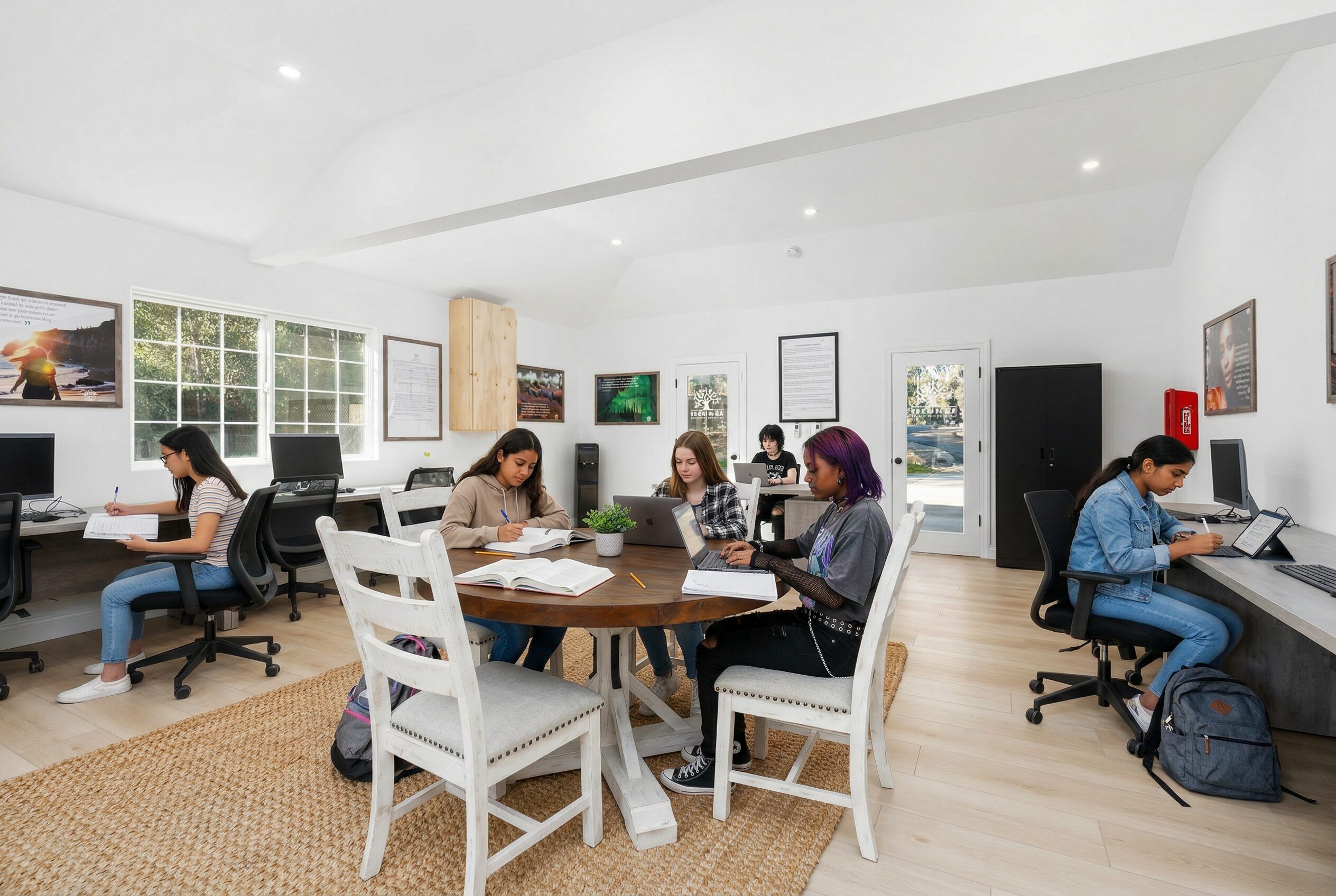
Teens in Muir Wood’s residential programs continue their education through our WASC-accredited Muir Wood Learning Centers — supplemental education programs for grades 7 through 12, staffed by experienced credentialed educators. Individualized learning plans help teens stay current with their home schools while they focus on healing. Success in the classroom becomes a vital part of restoring confidence, rebuilding executive functioning, and supporting long-term recovery.
Call Us To Learn More
Dual Diagnosis and Co-Occurring Care
For many teens who come to Muir Wood, the clinical picture involves more than one condition. Mental health and substance use travel together in adolescence far more often than they travel alone. A teen struggling with depression may be using substances to cope. A teen using substances often has underlying trauma, anxiety, or a mood disorder driving the use. Treating only one side of the picture, not the other, limits how far recovery can go.
When we treat teens in isolation — separating their mental health, substance use, and school struggles — we miss the full picture. A systems of care approach brings it all together. It’s how we move from managing symptoms to truly helping young people heal.
— Dr. David E. Smith, Chair, Addiction Medicine & MQAC, Muir Wood
Mental Health as the Foundation of Care
Muir Wood’s clinical work begins with mental health. Even for teens whose substance use is the presenting concern, our clinical model assumes there is usually an underlying emotional or psychological picture that deserves attention. Trauma, depression, anxiety, attention challenges, and emerging mood conditions are common contributors to adolescent substance use. Treating the substance use in isolation from the mental health context leaves the conditions that drive relapse untouched.
Integrated Substance Use Treatment
When substance use is part of the clinical picture, we treat it alongside the mental health side through a single integrated plan — not through separate tracks that compete for the teen’s attention. Our clinicians are trained to address both conditions simultaneously, and the group programming includes teens working through both mental health and substance use challenges. For adolescents, this integrated model produces substantially better outcomes than treating either condition alone.
Coordinated Continuum of Care
Dual diagnosis treatment doesn’t end at discharge. For teens stepping down from residential into our intensive outpatient programs in Petaluma or Clovis, the same clinical philosophy continues — integrated treatment of mental health and substance use, shared clinical leadership, and continuity that carries treatment gains into sustained recovery. For teens returning to outpatient care elsewhere, our team coordinates closely with receiving providers to support the transition.

Our Continuum of Care
We believe strong outcomes depend on continuity and collaboration. From admission through discharge, we coordinate closely with your teen’s existing providers and aftercare programs — whether that’s our IOP or another trusted outpatient partner. Our team stays in regular communication with the broader care network to support timely transitions, shared understanding, and a clear path forward.
Treatment gains made in residential and IOP care are sustained through what happens after. Our 16-week aftercare coaching program supports families through the critical transition period home, helping teens apply the skills they’ve built, helping parents navigate the predictable challenges that arise in the first 90 days home, and maintaining continuity with the clinical work done during treatment.
The Muir Wood Teen Difference
Our team partners closely with parents and caregivers from day one — clear updates, a personalized plan, and real-world tools you can use between sessions — so your teen can move toward stability, well-being, and lasting wellness alongside peers facing similar challenges.
Some of our key differentiators include:
Specialists in Adolescent Care
Everything we do is built for teens ages 12–17, not adapted from adult models. Our team includes adolescent psychiatrists and psychiatric nurse practitioners (PMHNPs), highly trained therapists, nurses, educators, and recovery counselors who specialize exclusively in adolescent mental health and substance use treatment. Working as an integrated team, they deliver evidence-based, developmentally appropriate care tailored to each teen’s unique needs.
Environments That Foster Connection and Growth
In serene, nature-rich settings, our campuses are unlike any other. With 24/7 care, teens spend their days as part of a broader community — engaging in therapy, academics, and outdoor activities that strengthen resilience and self-awareness. At night, they return to home-like residences to process, decompress, and connect with others. This balance of community and intimacy creates a unique healing environment where every moment becomes a part of the recovery process.
Expertise in Primary Mental Health + Substance Use
With expertise in treating both primary mental health and co-occurring substance use challenges, our trauma-informed approach helps teens heal deeply and build lasting change. We focus on the whole person — addressing both emotional well-being and underlying behavioral patterns — to support lifelong healing.
Support for the Whole Family
Healing doesn’t happen in isolation — it happens together. At Muir Wood, families stay actively involved through therapy, education, and a 16-week aftercare coaching program that builds trust, communication, and stability long after treatment ends.
Accessible, High-Quality Care Covered by Insurance
Muir Wood is committed to removing financial barriers to care by partnering with most major insurance providers, ensuring families can access high-quality, evidence-based treatment when it matters most.
Educational Support that Restores Confidence
Through our WASC-accredited academic program, students continue their education with personalized support. Success in the classroom becomes a vital step in restoring confidence, structure, and a sense of possibility.
Continuum of Care
We coordinate closely with your teen’s existing providers and aftercare programs — whether that’s our own IOP, another outpatient program, your teen’s existing therapist, or a care infrastructure we help arrange when one isn’t yet in place. For teens stepping into or out of Muir Wood residential care, shared clinical philosophy and close communication ensure progress continues without interruption.
Speak With a Teen Treatment Specialist
Connect with our admissions team today to learn how Muir Wood can support your family.
Start the Conversation
If your teen is struggling and you’re trying to understand what kind of treatment would actually help, our admissions team is available to listen, answer your questions, and help you understand what the right level of care might look like for your family. There’s no pressure, no obligation — just an honest conversation about what your teen needs right now.
Frequently Asked Questions About Our Therapies
Residential therapy is more frequent and more immersive than outpatient therapy. Teens in residential care receive at least two individual sessions per week, led by our team of therapists and recovery counselors, participate in multiple group therapy sessions each week, engage in experiential therapies daily, and live in a structured therapeutic environment that reinforces clinical work around the clock. Outpatient therapy, whether in our IOP or with a community provider, typically involves one to two individual sessions per week plus group programming for intensive outpatient. The right level of care is a clinical decision based on the severity of the teen’s challenges, safety considerations, and how much lower-intensity care has already been tried.
Teens in residential treatment receive at least two individual sessions per week, led by our team of therapists and recovery counselors. The primary therapist also leads weekly family therapy and coordinates with the broader clinical team around your teen’s treatment plan. In IOP, teens typically have weekly individual sessions alongside their group programming. Our clinical team adjusts frequency based on each teen’s clinical needs.
Yes, substantially. Weekly family therapy with your teen’s primary therapist, twice-weekly parent education classes, a weekly parent support group, regular treatment team huddle calls, and our 16-week aftercare coaching program are all part of the standard Muir Wood family programming. Family involvement is central to how we work — research consistently shows that teens whose families are actively engaged in treatment have better outcomes and more durable recovery than teens whose families stay on the sidelines.
No. Many teens make significant progress with therapy alone. When medication is appropriate, our psychiatric team follows a non-ideological, least-necessary approach — using medication only when clinically indicated, always in combination with evidence-based therapy, and always in close collaboration with families. Medication decisions are individualized based on the full clinical picture, and parents are full partners in those decisions.
Through an integrated clinical model — not through separate tracks that compete for the teen’s attention. For adolescents, mental health and substance use almost always travel together, and treating one without the other limits how far recovery can go. Our clinicians are trained to address both conditions through a single treatment plan, and our group programming includes teens working through both mental health and substance use challenges. This integrated approach produces substantially better outcomes than treating either condition alone.
Residential treatment at Muir Wood typically ranges from 45 to 60 days, with some stays extending to 90 days depending on clinical progress and insurance authorization. Our clinical team reviews each teen’s progress regularly and adjusts the treatment plan collaboratively with families. The therapeutic work that begins in residential treatment continues through IOP (for teens stepping down into that level of care) and through our 16-week aftercare coaching program.
Treatment doesn’t end at discharge. Our 16-week aftercare coaching program supports families through the critical transition period home, when the return to home environments, local schools, and familiar relationships puts the gains of treatment to the test. Aftercare coaches help teens apply what they’ve built during treatment, help parents navigate the predictable challenges of the first 90 days home, and coordinate with outpatient providers who will continue the clinical work. For teens stepping down from residential into our IOP, there’s clinical continuity across both levels of care. For teens returning to providers in their home community, our team coordinates the handoff to ensure a smooth transition.